
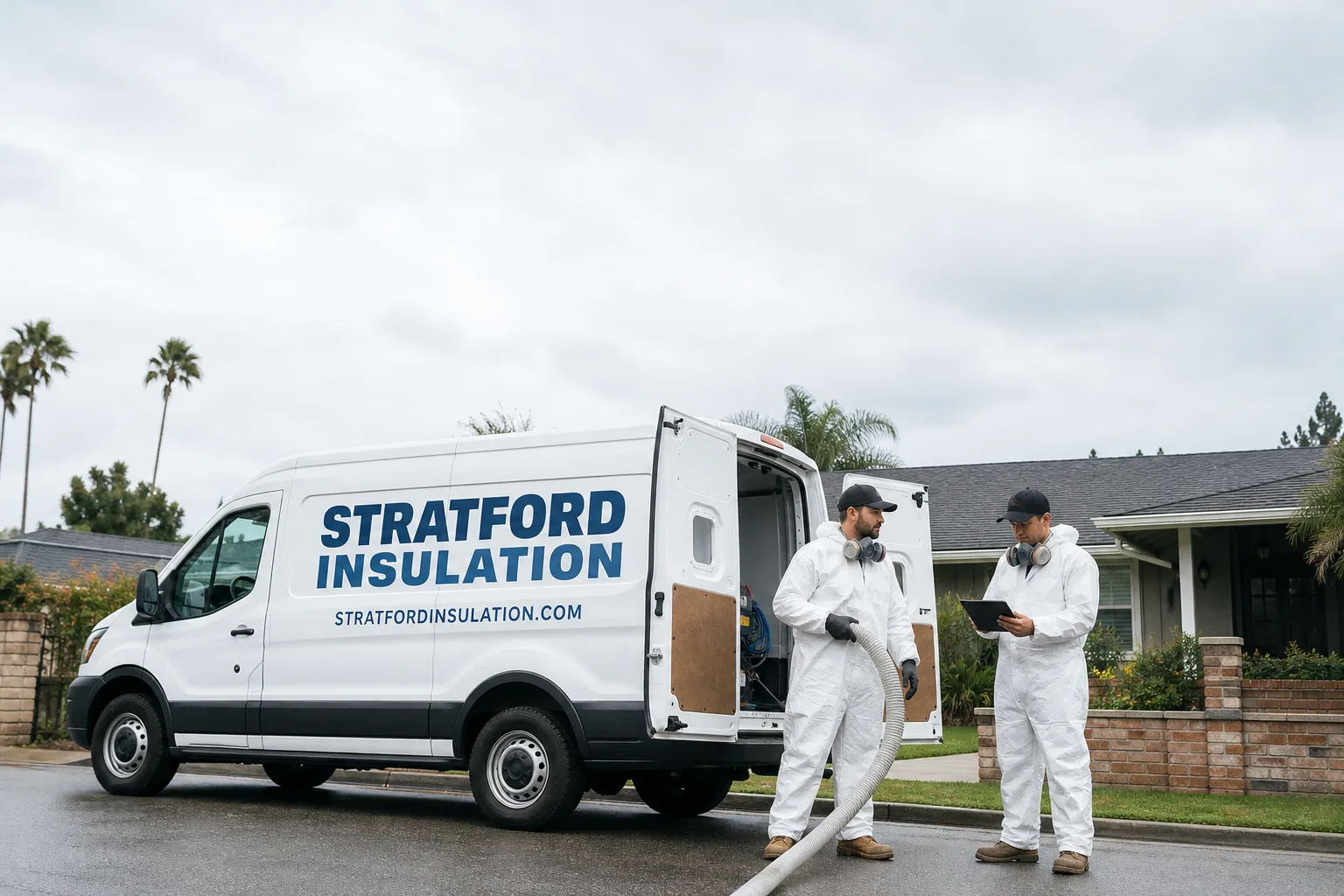
Fast, Reliable Spray Foam Insulation Across San Joaquin Hills
Spray foam insulation in San Joaquin Hills runs $2.20 to $5.80 per square foot for open-cell and $3.60 to $7.40 per square foot for closed-cell, depending on depth and substrate. Stratford Insulation serves the 92657 corridor with same-week scheduling and free attic assessments. If your stucco and tile home bakes through the afternoon and your AC can’t keep up, the problem is rarely the HVAC. It’s the thermal envelope. Call Noel and the crew at (844) 643-2736.
Why Stratford Insulation Is San Joaquin Hills’s Preferred Spray Foam Insulation Company
San Joaquin Hills homeowners deal with a specific problem: Mediterranean-style construction that sheds winter rain beautifully but absorbs inland summer heat like a kiln. Our team has spent years crawling through the attics off Bonita Canyon Drive, Newport Coast Drive, and the ridge lines above San Joaquin Hills Road, and we know what those spaces look like. Cracked stucco. Compressed fiberglass batts. Attic temperatures that hit 140 degrees by 2 p.m. We also know what the HOAs require on street-visible vents, which matters more here than any city we serve. When a San Joaquin Hills customer calls, we schedule a walkthrough within days, not weeks. Estimates are free and written with the exact R-value and material spec, not a vague line item. The reviews we’ve earned from homeowners in 92657 consistently mention the same thing: we explain the why before we touch the how. That’s not marketing language. That’s just how Noel Caraway runs every job.
Stratford Insulation is a dedicated insulation contractor, not a generalist. That distinction matters when you’re choosing between open-cell and closed-cell foam under a concrete tile roof that radiates heat for hours after sunset. We install products from eight manufacturers, including Icynene and Demilec for spray foam, Rockwool for mineral wool, and GreenFiber for cellulose. That range means we match the material to the problem, not the other way around. Backed by brands builders and building scientists trust.
Spray Foam Insulation for San Joaquin Hills Homes
Spray foam is the only insulation that air-seals while it insulates, which is why it outperforms batts and loose fill in the specific conditions San Joaquin Hills throws at a house. Hot, dry summers heat-soak concrete tiles and stucco walls. Santa Ana winds drive dust and heat into soffit gaps. Ridge-line homes get the worst of both. Our San Joaquin Hills spray foam work focuses on attics, roof decks, rim joists, and garage ceilings. A typical open-cell attic application in 92657 costs $4,800 to $9,600 for a 2,000 to 2,500 square foot home. Closed-cell runs higher, $7,200 to $14,500, because the material delivers a higher R-value per inch and adds structural rigidity. Every estimate includes a thermal camera pass so you can see exactly where the heat is entering before we recommend a single product.
Open-Cell Spray Foam for Attics and Roof Decks
Open-cell spray foam in San Joaquin Hills works best when applied to the underside of the roof deck, creating a conditioned attic that stops heat before it ever reaches your living space. The foam expands to fill the irregular cavities between rafters, sealing the penetrations around recessed lights, ceiling fans, and attic hatches. In a tile-roof home, open-cell also dampens the hollow, echoing sound of rain and wind against the concrete tiles. That acoustic benefit is something fiberglass cannot deliver. Homeowners with vaulted ceilings and bonus rooms over garages consistently report the biggest comfort shift after open-cell roof deck application.
Closed-Cell Spray Foam for Rim Joists and Garage Ceilings
Closed-cell foam delivers about R-6.5 per inch and acts as a vapor barrier, which makes it the right call for rim joists where warm, moist air meets the foundation. In San Joaquin Hills homes built in the 1980s and 1990s, rim joist cavities are rarely insulated at all. Closed-cell foam in those bays stops both heat gain and the dust infiltration Santa Ana winds push through. Garage ceilings over conditioned bonus rooms are another common closed-cell application; the foam seals the floor assembly and quiets the space below. Expect to pay $1,900 to $3,400 for a typical rim joist package, $2,800 to $5,200 for a garage ceiling.
Spray Foam Insulation Contractors in San Joaquin Hills
Spray Foam Insulation Contractors in San Joaquin Hills need to understand how HOA architectural review affects a retrofit before the first truck arrives. In 92657, street-visible attic vents often require screening or louvered covers that match the stucco trim. That means our crews coordinate vent placement and trim spec with the association’s design guidelines, something contractors working in Newport Beach or Irvine rarely have to navigate. The pre-job approval step adds a few days to the timeline, but skipping it creates compliance headaches and rework. We handle that communication directly. Homeowners receive a written scope that includes the HOA-required vent treatment, so there are no surprises when the board asks about it.
Coordination With HOA Architectural Review
Ridge-line and canyon-facing homes in San Joaquin Hills have stricter visibility standards than street-level lots. Before we spray, we document existing vent locations, photograph the street-facing elevations, and submit a vent screening plan if the association requires one. The actual foam application happens only after the design committee signs off. That discipline protects you from a stop-work order.
The Ridge-Line Ventilation Problem
Many homes along Bonita Canyon and the upper reaches of Ridge Park Road lack adequate attic ventilation. Spray foam changes the ventilation equation entirely: applied to the roof deck, it creates a sealed, conditioned attic that no longer needs traditional venting to manage temperature. But the existing vents still need to be addressed. We either seal them permanently, which is common in conditioned attic retrofits, or re-screen them per HOA spec. Inadequate ventilation around spray foam causes heat to concentrate at the roof sheathing, accelerating shingle and tile underlayment wear. Our crews always evaluate the full assembly, not just the insulation layer.
Open Cell Spray Foam in San Joaquin Hills
Open Cell Spray Foam in San Joaquin Hills addresses the single biggest comfort complaint we hear from 92657 homeowners: upstairs rooms and bonus spaces that spike 8 to 12 degrees above the main floor by mid-afternoon. We recently sprayed open-cell foam in a 1990s Mediterranean-style home off Ridgeline Drive, where the vaulted bonus room over the garage had baked its existing fiberglass into a compressed mat under the tile roof. After sealing the attic penetrations and applying Icynene open-cell foam to the underside of the roof deck, we screened the new vent openings with custom louvered covers that matched the HOA-approved stucco trim. The homeowner reported the upstairs room finally held its temperature through the afternoon sun. The job required careful masking of the exposed rafters in the open-beam ceiling below. That’s the work most insulation crews won’t touch, because it takes patience and finish carpentry skill.
How Open Cell Handles Radiant Heat
Open-cell foam slows heat transfer by trapping air in millions of tiny, open pores. It performs best against conductive and convective heat flow, which is exactly what happens when a concrete tile roof absorbs sun for six hours and then releases that heat downward into the attic. The foam creates a continuous thermal boundary at the roofline. Air movement through the attic stops. Your ductwork, if any runs through the attic, no longer sits in a 130-degree environment. That single change reduces AC runtime measurably in San Joaquin Hills summers.
Acoustic Damping for Tile Roofs
Concrete tile roofs amplify sound. Rain, Santa Ana wind gusts, even birds landing on the ridge line transmit through an uninsulated attic ceiling. Open-cell foam’s soft, absorptive structure cuts that noise significantly. Homeowners in San Joaquin Hills who install open-cell at the roof deck often describe the house as noticeably quieter, not just cooler. That acoustic benefit is a real, sellable performance gain beyond thermal R-value.
Trusted Brands We Service in San Joaquin Hills
Stratford Insulation installs Icynene and Demilec spray foam, the two product lines we specify most often for San Joaquin Hills homes. Icynene’s open-cell formula works well for conditioned attics and vaulted ceilings; Demilec’s closed-cell line suits rim joists and garage ceiling applications where a vapor barrier matters. For homeowners who want to evaluate alternatives before committing to foam, we also install Owens Corning fiberglass, Rockwool mineral wool, and GreenFiber cellulose. That means your material recommendation is driven by your house, not our inventory. Attic to crawl space, blown-in to spray foam, one specialist, every method.
Common Spray Foam Insulation Problems We See in San Joaquin Hills Homes
- Foam applied without addressing inadequate attic ventilation in ridge-line homes. The heat has nowhere to dissipate, the roof sheathing cooks, and the foam degrades prematurely. We evaluate ventilation before we ever pick up a spray gun.
- HOA screening requirements for street-visible vents overlooked. A foam retrofit changes vent placement and appearance. If the trim doesn’t match the association’s approved palette, you’re looking at compliance notices and rework costs. We handle that approval step up front.
- Thermal bypasses in vaulted ceilings and bonus rooms. Unsealed penetrations where foam can’t reach create pathways for heat to flow around the insulation. We seal can lights, junction boxes, and framing gaps before the foam goes in.
- Undersized foam depth on existing attic floors. Some earlier retrofits applied a thin layer of foam and called it done. A 3-inch open-cell application delivers about R-10.5; the same space treated to 6 inches gets R-21. Depth matters, and we quote the R-value, not just the square footage.
Pricing for Spray Foam Insulation in San Joaquin Hills, CA
Spray foam pricing in San Joaquin Hills runs higher than in flat-grade Orange County cities, mostly because HOA coordination, stucco-matched vent screening, and access constraints on ridge-line lots add labor. A typical open-cell attic retrofit in 92657 runs $2.20 to $3.40 per square foot of applied surface; closed-cell runs $3.60 to $5.60 per square foot. A full roof deck application on a 2,400 square foot home will usually land between $7,800 and $12,900. Rim joist packages run $1,900 to $3,400. Garage ceiling applications run $2,800 to $5,200. These are installed prices for San Joaquin Hills’s market, including HOA vent treatment where applicable. Call (844) 643-2736 for a written quote on your specific floor plan. Estimates are free and we walk the attic with a thermal camera as part of the visit.
We Also Serve Cities Near San Joaquin Hills
Stratford Insulation works throughout central and coastal Orange County. In addition to Spray Foam Insulation in San Joaquin Hills, we regularly schedule projects in Newport Beach, Irvine, Costa Mesa, and Tustin. Same crews, same material spec, same HOA-aware process. A job in Newport Coast or Turtle Ridge gets the same thermal camera walkthrough as a job in Harbor View or Spyglass Hill.
Serving San Joaquin Hills, CA — Our Local Coverage Area
We’re based in the San Joaquin Hills area and know this community well, including our Reflectix service in San Joaquin Hills. Use the map below to see our service coverage — if you’re nearby, we can almost certainly help.
FAQs About Spray Foam Insulation in San Joaquin Hills
Yes, if the project changes any street-visible vent appearance or placement, your HOA will likely require architectural review before work begins. Stratford Insulation handles the documentation and screening plan submission. The foam application waits until the design committee signs off, which typically adds three to seven days to the timeline. Call (844) 643-2736 and we’ll check your association’s specific guidelines before you commit.
Spray foam outperforms fiberglass batts and loose fill under concrete tile because tiles store heat and release it downward for hours after the sun goes down. Foam applied to the roof deck blocks that radiant transfer before it reaches the attic airspace. Fiberglass on the attic floor slows conductive heat but leaves the attic itself hot, which is why AC ducts in those attics work so hard in summer. A conditioned attic with roof deck foam typically runs 15 to 25 degrees cooler than a traditionally insulated attic in 92657.
Yes, and it’s often the best option. Open-cell foam conforms to the irregular rafter bays in vaulted ceilings, seals the penetrations around recessed lights and ceiling fans, and does not add significant weight to the roof assembly. The application requires careful masking of exposed rafters and beams, which is standard practice on our San Joaquin Hills jobs. The foam also quiets the rain and wind noise that concrete tile roofs transmit. Call (844) 643-2736 for an attic-specific assessment.
For most San Joaquin Hills Mediterranean-style homes, we recommend Icynene open-cell foam for roof decks and vaulted ceilings, and Demilec closed-cell foam for rim joists and garage ceilings where a vapor barrier and higher R-value per inch matter. Both products have long track records in coastal and inland Orange County conditions. We’ll spec the exact product and depth based on your home’s assembly and HOA requirements. Estimates are free and include the brand name on the written quote.
Santa Ana winds drive hot, dry air and fine dust into any unsealed gap in the building envelope: soffit edges, rim joists, can light housings, attic hatches. Spray foam addresses this by air-sealing while it insulates, which fiberglass and cellulose cannot do. The foam forms a continuous barrier that blocks wind-driven infiltration. In San Joaquin Hills homes built before 2000, the rim joist bays and eaves are usually the leakiest points, and they’re exactly where we start. Call (844) 643-2736 to schedule a thermal camera walkthrough.
Written by Noel Caraway, Owner at Stratford Insulation, serving San Joaquin Hills and Orange County with spray foam, blown-in, and attic insulation since day one.