Attic Insulation Cost Guide: What Garden Grove Homeowners Pay in 2026
Most Garden Grove homeowners will pay between $1,600 and $4,800 to insulate an attic in 2026, with the typical 1,200 to 1,800 square foot tract home landing around $2,400 to $3,200 for blown-in fiberglass or cellulose. That range exists because material type, attic access, existing insulation condition, and whether air sealing is included all move the final number independently. If you’d rather skip the research and get a straight answer for your specific house, call (844) 643-2736 and we’ll walk you through it.
Here’s the thing most cost guides won’t tell you: two quotes for the same Garden Grove attic can differ by 60% and both be legitimate. The gap isn’t contractor greed. It’s that each bidder is defining the scope differently. One includes baffles at every soffit vent. The other doesn’t. One assumes the old insulation stays in place. The other is hauling it out. One is quoting R-30 settled depth. The other is quoting R-38. If you don’t read bids line by line, you’ll either overpay for something you didn’t need or underbuy and wonder why your upstairs is still hot in August.
Key Takeaways
- Blown-in fiberglass runs $1.10 to $1.80 per square foot installed in Garden Grove; blown cellulose runs $1.25 to $2.00.
- Fiberglass batts cost $1.50 to $2.50 per square foot but rarely make sense for existing attics with irregular joist spacing.
- Spray foam costs $3.00 to $7.00 per square foot and is the only option that air seals while it insulates.
- Quotes that exclude air sealing, baffles, and attic hatch insulation are not comparable to quotes that include them.
- Payback on a $2,800 attic insulation job in Garden Grove typically lands between 4 and 7 years based on local SCE and SoCalGas rates.
We’re Stratford Insulation home-based specialists, and we install fiberglass, mineral wool, spray foam, and cellulose. That means when we give you a cost breakdown, we’re not steering you toward the one product we happen to carry. The numbers below reflect what we actually see in Garden Grove attics week after week.
What Attic Insulation Actually Costs in Garden Grove in 2026
Garden Grove’s housing stock works in our favor when it comes to predictable pricing. The majority of attics we work in sit over homes built between 1955 and 1980, with shallow hip roofs, 2×4 or 2×6 ceiling joists, and access hatches in a hallway ceiling or closet. These attics are cramped, which slows installers down. But they’re also geometrically simple, which keeps material waste low. Net result: labor runs slightly higher than a wide-open newer attic, but material costs stay flat.
Here’s the per-square-foot reality for Garden Grove in 2026:
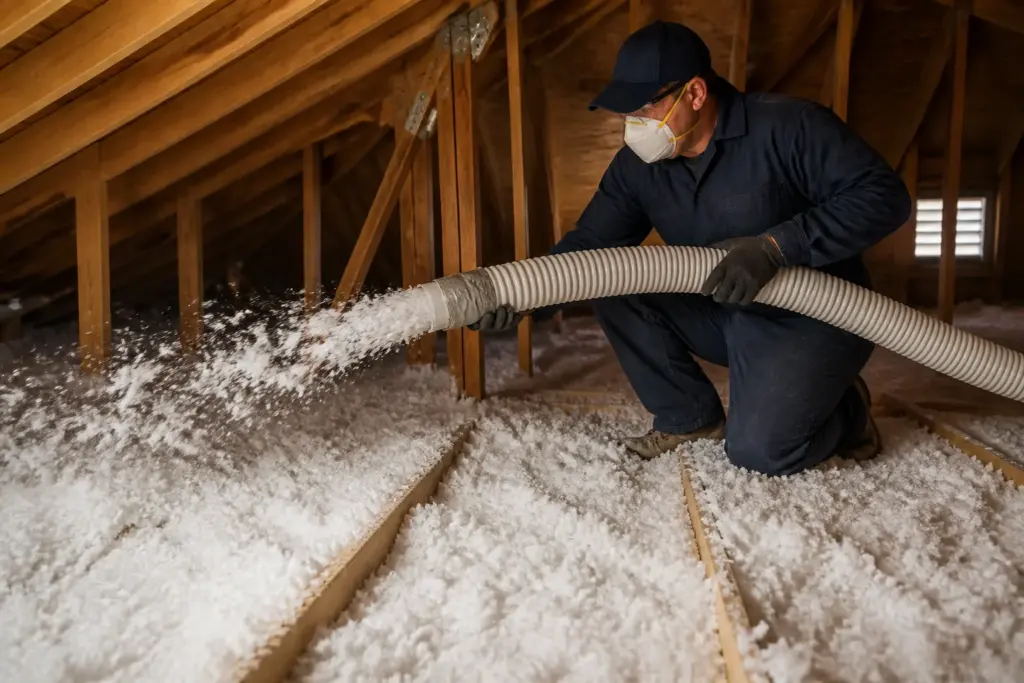
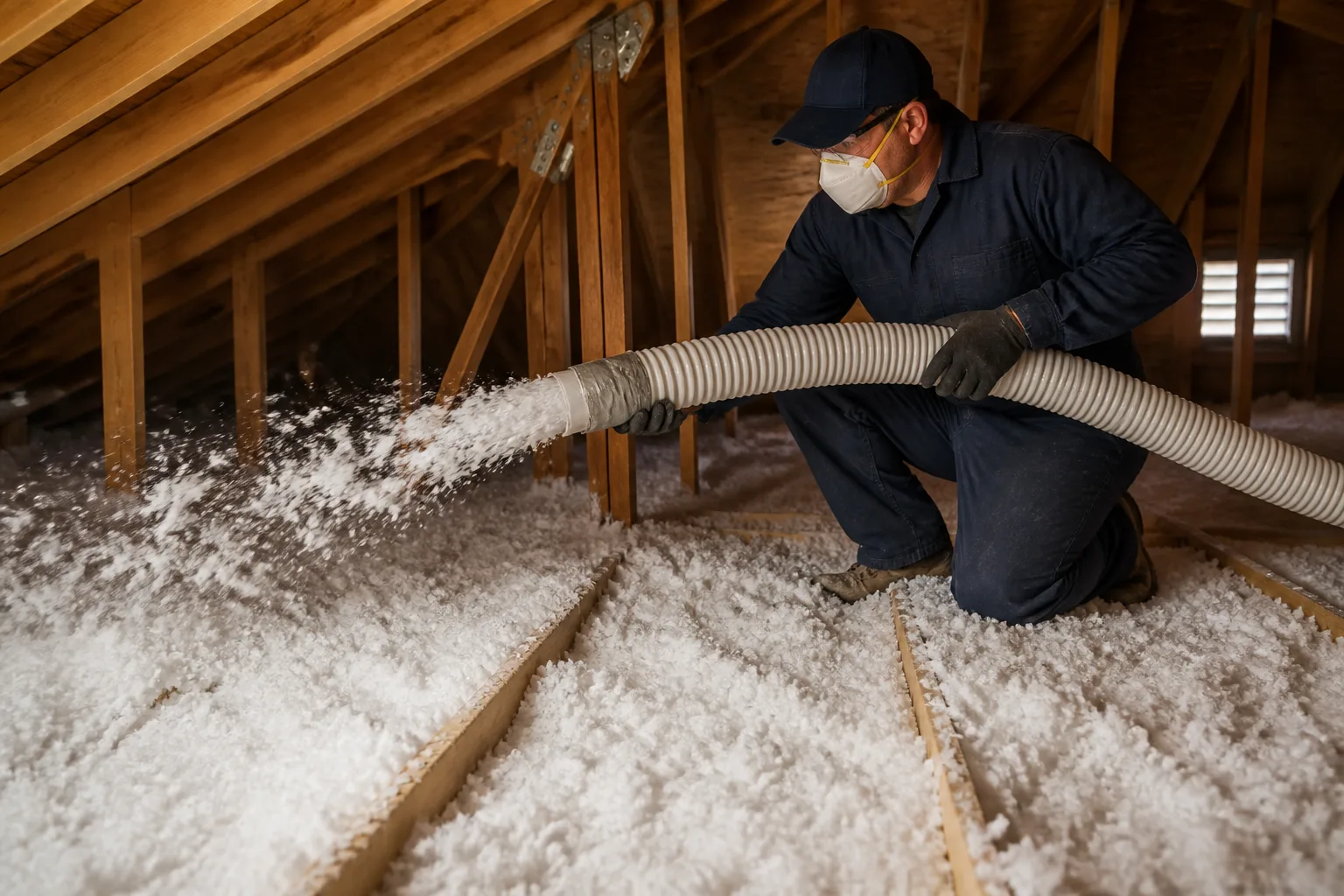
- Blown-in fiberglass: $1.10 to $1.80 per sq ft. This is the workhorse option. It’s what most tract homes in the city already have, just often at R-19 levels that have flattened over 40 years. Loose-fill fiberglass doesn’t settle as much as cellulose, and it’s the fastest install.
- Blown-in cellulose: $1.25 to $2.00 per sq ft. We install GreenFiber cellulose for homeowners who want recycled content without sacrificing R-value. Cellulose settles about 10 to 15%, so a good installer blows it dense from day one.
- Fiberglass batts: $1.50 to $2.50 per sq ft. Batts make sense in new construction or open attics with uniform joist bays. In older Garden Grove homes where joist spacing varies, batts get compressed, and compressed fiberglass loses R-value fast.
- Open-cell spray foam: $3.00 to $4.50 per sq ft. This is a roof deck application, not a floor application. It turns the attic into conditioned space and air seals every seam. We install Icynene open-cell for this application.
- Closed-cell spray foam: $4.50 to $7.00 per sq ft. Higher R-value per inch, and it doubles as a vapor barrier. Demilec closed-cell goes into attics with moisture concerns or when roof deck space is limited.
For a 1,500 square foot attic floor, blown-in fiberglass at $1.30 per square foot hits roughly $1,950. That’s not a teaser price; that’s a real number with a real R-value attached. Bump it to R-38 settled depth and you’re looking at $2,200 to $2,600, assuming the existing insulation stays in place as a base layer.
What Quotes Commonly Exclude (And Why the Cheap Bid Rarely Is)
The cheapest attic insulation bid in Garden Grove is usually a material-only number: blow X inches of fiberglass over the existing insulation and call it done. That’s a valid scope for some homes. It’s also the scope most likely to leave you with an attic that’s still 140 degrees in July because nobody addressed the actual problems.
When we review a competing bid for a homeowner, here’s what we’re checking for explicitly:
- Air sealing labor. The top plates, plumbing penetrations, can light housings, and electrical chases in a Garden Grove attic can leak as much conditioned air as an open window. Air sealing adds $400 to $800 to the job but often moves the energy needle more than the insulation itself.
- Baffles at every soffit vent. If you’re adding insulation depth, you need baffles to keep the intake vents from getting buried. Skipping them means you’ve insulated your way into a roof deck moisture problem. Each baffle is $2 to $4 in material, but the labor to reach into the tight eave space on a shallow hip roof is real.
- Attic hatch insulation. It’s a 2 by 2 foot panel that nobody insulates. We blow insulation up there and it’s like leaving a window cracked. A proper hatch treatment costs $100 to $200 and most cheap bids pretend it doesn’t exist.
- Removal of old degraded material. If the existing insulation is water-damaged, rodent-infested, or compressed to half its original depth, you can’t just blow over it. Removal runs $1.50 to $2.50 per square foot of floor area in Garden Grove. It’s labor-intensive and it’s the first thing cut from a low bid.
The saying we use with homeowners: match the material to the problem, not the other way around. If you don’t know what problem you’re solving, the low number will always win the bid and lose the war.
How Garden Grove Home Characteristics Affect Install Time and Labor Cost
Garden Grove homes are not like the sprawling ranch houses with walkable attics you see in other parts of Orange County. The city was built out in the post-war boom, and the housing stock reflects it. What that means for your quote:
- Shallow hip roofs create eave areas that are nearly inaccessible. Running baffles and reaching the outer 2 feet of the attic floor means crawling on your stomach across ceiling joists. That time shows up in labor cost. A house in Garden Grove’s older neighborhoods will take 1.5 to 2 times longer to properly detail than a truss-roof house with 6 feet of headroom.
- 1200 to 1800 square foot tract homes are consistent enough that we can quote them fairly accurately without seeing the attic. The variables that shift the number are access hatch size, existing insulation condition, and whether the HVAC ducts run through the floor of the attic, which they do in most of these homes.
- Older framing with true 2×4 rafters means roof deck spray foam goes in at a slightly different depth than on modern trussed roofs. It doesn’t make or break the project, but it changes the math if you’re comparing open-cell vs closed-cell on a per-board-foot basis.
We pulled an old batt insulation job out of a house near Euclid and Lampson a few months ago where the original installers had left a 4-foot-wide strip completely bare because the eave was too tight to reach. That’s not a material problem. It’s a labor reality. It’s also why we send a real person into the attic before we quote, not just a measuring wheel on a pole.
The Honest ROI Math for Garden Grove Energy Bills
National ROI estimates for attic insulation are sometimes a little optimistic for Orange County, because our climate is mild and our heating and cooling loads sit lower than, say, Phoenix or Minneapolis. Garden Grove has a Mediterranean climate with about 2,800 cooling degree days and 1,200 heating degree days annually. That means air conditioning is the dominant energy cost, and attic insulation is the single highest-leverage upgrade you can make to cut it.
Based on current Southern California Edison and SoCalGas rates in Garden Grove, here’s what a $2,800 attic insulation project (including air sealing and hatch treatment) typically returns:
- Summer months: A well-insulated attic reduces upstairs AC runtime by 25 to 35% during peak heat. On a house with a 3-ton AC running 6 hours a day in July and August at SCE’s baseline-adjacent rates, that’s $50 to $75 per month in savings during the hottest four months.
- Winter months: Gas-heated homes lose less heat through the ceiling, but the smaller temperature difference means savings drop to $20 to $30 per month from December through February.
- Annual total: $400 to $650 in combined electrical and gas savings for a typical Garden Grove tract home.
- Payback: 4 to 7 years on the full $2,800 project. If you include the federal tax credit (30% of materials, capped at $1,200 per year for insulation), the effective out-of-pocket drops to about $2,240 and payback tightens to 3.5 to 5.5 years.
Those numbers hold up because SCE’s tiered rate structure punishes heavy summer use. If your upstairs bedrooms are hitting 80 degrees by 4 p.m., your AC is running all afternoon at top-tier pricing. Insulation is the difference between staying in tier 1 and climbing into tier 3 every billing cycle.
California Rebates and Federal Tax Credits for 2026
Garden Grove homeowners have access to a stack of incentives in 2026 that can meaningfully cut the cost of attic insulation. The qualifications are specific, so it’s worth understanding the thresholds before you assume you qualify.
- Federal 25C tax credit: 30% of the material cost for insulation, up to $1,200 per year. Insulation qualifies at R-13 for walls and R-19 for attics, and the credit applies to materials only, not labor. You don’t need to replace all your insulation; adding to existing counts. The IRS requires the product be at least partially new, so reusing salvaged material doesn’t qualify.
- California Energy-Smart Homes program: This runs through the state’s investor-owned utilities, including SCE and SoCalGas. Attic insulation upgrades that bring the home to R-38 or above can qualify for $0.25 to $0.50 per square foot in rebates, depending on the home’s baseline and whether air sealing is bundled. The program requires a pre-installation verification, so you need a contractor who’s registered with the program.
- Garden Grove municipal programs: The city’s sustainability division periodically runs insulation incentive pilots through Southern California Association of Governments funding. These come and go; checking the city website before you sign a contract is smart, because the funds are first-come, first-served.
The practical takeaway: a $2,800 project could net out to $2,000 to $2,200 after incentives, depending on how much material cost you can claim. We’ll flag which programs apply to your project when we bid, and we don’t charge for that analysis. It’s part of the estimate.
How to Read an Attic Insulation Bid in Garden Grove
Bids for attic insulation in Garden Grove are usually one page and maddeningly vague. Here’s how to make sense of what you’re holding:
- Look for R-value, not just inches. “Blow 12 inches” means nothing if the product is low-density. Ask for the settled R-value. In Orange County, R-38 is the practical standard for attic floors. R-49 is better but diminishing returns kick in, especially for our climate.
- Check whether air sealing is called out as a separate line item. If the bid says “insulation only” and your attic still has open top plates, you’re paying to insulate a leaky box. The insulation will work. It’ll just work less.
- Confirm the existing insulation plan. Does the bid say “blow over existing” or “remove and replace”? If your existing insulation is from the original construction in the 1970s, it’s likely compacted and full of dust. Blowing over it is like putting new shingles over rotted decking.
- Look for the attic hatch and access door treatment. If the bid doesn’t mention it, it’s not included. Period.
If you’re comparing two bids side by side and one of them is missing all the things we listed earlier in this article, the prices aren’t comparable. Ask each bidder to line-item the scope. The one who can’t is telling you something.
When to Call a Pro
Attic insulation in Garden Grove is not a weekend project. The attic itself is hot, cramped, and full of hazards ranging from exposed nails to live electrical wiring. If your project involves removing old material, air sealing, or spray foam application, that’s contractor territory. Blown-in insulation over a clean attic with easy access is the only scenario where a skilled DIYer might come out ahead, and even then, you’re renting a machine, buying baffles, and crawling through a space that’s 130 degrees in summer.
If you’d rather have a specialist handle it, we offer Attic Insulation in Garden Grove as one of our core services, alongside Spray Foam Insulation in Garden Grove and Blown In Insulation in Garden Grove. One contractor, every method, no coordinating three crews.
The Bottom Line
Attic insulation in Garden Grove costs what it costs because of scope, not mystery. A properly detailed job with air sealing, baffles, hatch treatment, and the right material for your roof type will land between $2,000 and $3,500 for most homes in this city. A $1,200 flyer special is almost always doing less, and a $8,000 spray foam quote is usually doing more than the house needs.
We install Owens Corning and Johns Manville fiberglass, Rockwool mineral wool, Icynene and Demilec spray foam, and GreenFiber cellulose. That’s not a brand list for show. It means when we tell you a particular material is right for your attic, it’s because we compared it against the alternatives we also carry, not because it’s the only hammer we own.
If you’re in Garden Grove and want a real number, Stratford Insulation offers free estimates. Call (844) 643-2736.
Frequently Asked Questions
Attic insulation in Garden Grove runs $1.10 to $2.00 per square foot for blown-in fiberglass or cellulose, and $3.00 to $7.00 per square foot for spray foam applied to the roof deck. A 1,500 square foot attic floor with blown-in insulation typically totals $2,200 to $3,000 including air sealing and hatch treatment. Call (844) 643-2736 for a line-item quote on your specific attic.
Yes, if you run air conditioning between June and October. Attic insulation reduces AC runtime by 25 to 35% in peak summer heat, which translates to $400 to $650 in annual energy savings for a typical Garden Grove tract home. The payback window of 4 to 7 years shrinks further when federal tax credits and California utility rebates are applied.
R-38 is the practical standard for attic floors in Garden Grove and the rest of Orange County. It’s the level required by California Title 24 for new construction and the level at which most existing homes see meaningful energy savings. R-49 delivers slightly better performance but the cost per additional R-value point climbs steeply, especially in our mild climate.
Only if the existing insulation is water-damaged, rodent-infested, or compressed to less than half its original depth. In Garden Grove attics where the original 1970s fiberglass has flattened to R-11 or R-13, removal costs $1.50 to $2.50 per square foot and is worth it before blowing new insulation on top. If the existing material is dry and reasonably intact, blowing over it is a viable and cost-effective approach.
Written by the team at Stratford Insulation, serving Garden Grove since 2015.
Need Insulation Help?
Call Stratford Insulation — licensed & insured, here with fast after-hours help in Garden Grove.
(844) 643-2736