
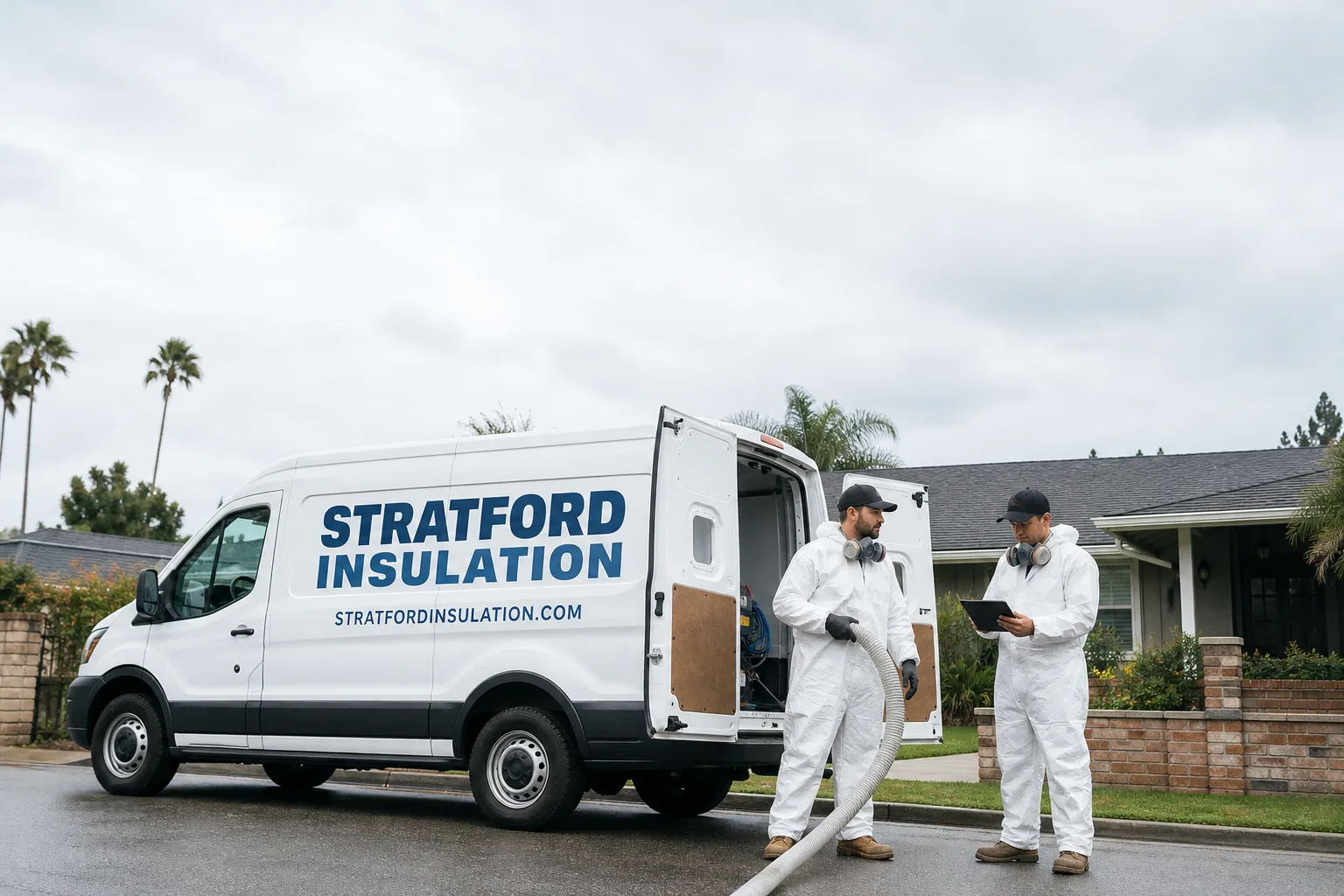
Fast, Reliable Spray Foam Insulation Across Orange
Spray foam insulation in Orange, CA typically costs $2.50 to $6.50 per board foot installed, with a standard closed-cell attic job in a 1,500-square-foot ranch home running $6,000 to $13,000. We get calls from Orange homeowners every week dealing with attics that hit 140°F in August and bedrooms that never cool down. Our crews know the difference between a 1950s bungalow near Old Towne and a 1970s tract home east of the 55. If your energy bills climb every summer and your AC runs nonstop, call (844) 643-2736 for a straight answer and a free estimate.
Why Stratford Insulation Is Orange’s Preferred Spray Foam Insulation Company
Orange presents a specific challenge for insulation work, and we’ve learned it house by house. The city’s mid-century tracts and older historic homes share thin wall cavities and attics that were never built for inland heat. Homeowners tell us the same thing after we finish: rooms finally hold temperature, and the AC cycles off instead of running from noon to midnight. Noel Caraway started Stratford Insulation with a simple approach: match the material to the problem, not the other way around. That’s why we install both Icynene and Demilec spray foam products, plus fiberglass, mineral wool, and cellulose when the job calls for something else.
We’re based in Garden Grove, which puts our trucks 15 minutes from most Orange neighborhoods. When a homeowner near Villa Park Road calls about a hot attic or a failed insulation job, we can usually have a technician out the same week to assess. Because we’re insulation-only contractors, not a generalist crew squeezing foam in between roofing jobs, our recommendations come from what the house actually needs. A 1960s ranch with settled original batts gets a different answer than a newer two-story in the Serrano Heights area. That diagnostic work is the difference between a quote and a real solution.
Our work in Orange has taken us through the 92863, 92864, 92865, and 92866 ZIP codes, from Old Towne’s wood-frame bungalows to the larger lots along Orange Park Boulevard and east toward the Santiago Hills. We’ve seen what inland sun does to spray foam installed without attention to surface prep, and we know what it takes to get adhesion and R-value right the first time. Homeowners keep our number because we show up, explain what we found, and don’t push a product that doesn’t fit the house.
Closed Cell Spray Foam Insulation in Orange
Closed cell spray foam insulation is the workhorse for Orange attics and rim joists, and it’s what we recommend first for homes that bake under inland heat. Closed cell foam cures to a rigid, dense layer that does two jobs at once: it seals air leaks and adds significant R-value per inch. In an Orange home where summer attic temperatures climb 15 to 20 degrees higher than coastal Orange County, that air-sealing function matters as much as the insulation value. We typically install closed cell foam at 1.5 to 3 inches in rim joist cavities and 4 to 5 inches in roof deck applications, depending on the assembly and the homeowner’s goals.
Where Closed Cell Earns Its Cost
Closed cell foam costs more per board foot than open cell, but it earns the price in specific Orange situations. Homes with HVAC equipment or ductwork in unconditioned attics benefit immediately, since the attic stops acting like an oven that fights the air conditioner all afternoon. Older ranches in central Orange with cracked sheathing and air-worn framing also see real gains from the structural rigidity closed cell adds. And for rim joist sealing in crawlspaces, nothing outperforms closed cell for stopping both air infiltration and moisture vapor.
Roof Deck and Ridge Applications
We spray closed cell directly to the underside of roof decks in Orange homes where unvented attic design makes sense. This is common in mid-century ranches where the ceiling plane is difficult to air-seal properly and the original blown insulation has settled. The foam brings the attic inside the conditioned envelope, which keeps stored belongings from cooking and protects plumbing from extreme heat cycles.
Open Cell Spray Foam in Orange
Open cell spray foam is the softer, vapor-open cousin that works well in interior wall cavities and other applications where cost per R-value matters more than rigidity. In Orange, we use open cell frequently on interior partition walls for sound control around home offices and bedrooms, and in garage ceiling retrofits where a homeowner wants to tame a boiling garage without spending closed-cell money. Open cell delivers about R-3.7 per inch and expands aggressively to fill odd-shaped cavities, which makes it a smart fit for the irregular framing found in older Orange homes.
The Right Tool for Interior Retrofits
In a 1950s bungalow near Old Towne, wall cavities are often narrow, irregular, and shared with knob-and-tube-era wiring. Open cell foam flows around those obstacles better than rigid alternatives and doesn’t trap moisture in wood-framed walls the way some materials can. Because it’s vapor-permeable, it lets the wall assembly dry toward the interior, which matters in a climate that cycles between dry Santa Ana heat and occasional winter rain.
Garage Ceiling and Bonus Room Work
Garage ceiling spray foam is one of the most common Orange requests we get from homeowners who use the garage as a workshop, gym, or secondary living area. Open cell foam on the garage ceiling and shared walls cuts the heat transfer from an uninsulated garage into bedrooms above. It’s faster to install than closed cell and brings immediate thermal comfort improvement for a lower material cost.
Trusted Brands We Service in Orange
Our Spray Foam Insulation team installs Icynene and Demilec spray foam systems, two of the industry’s most recognized names, and we back that up with proper surface prep, correct foam temperatures, and careful depth control. When an Orange job calls for a hybrid approach, we can bring in Owens Corning or Knauf fiberglass for batt applications, or Johns Manville for specialized areas. Having access to eight manufacturers across every major insulation type means we recommend what the house needs, not what we happen to have on the truck. Product arrives quickly, and we keep application equipment calibrated for consistent results in Orange’s summer heat.
Common Spray Foam Insulation Problems We See in Orange Homes
- Closed cell foam sprayed too thin in east-side tract attics. A 1-inch layer doesn’t hit the R-value Orange’s inland heat demands. We see homes where the previous contractor under-sprayed and the attic still hits 130°F by 2 p.m.
- Open cell foam left exposed in vented attics without ignition barriers. Code requires a thermal barrier or ignition barrier in many attic configurations. We’ve corrected jobs where raw open cell sat exposed, creating both a fire-code violation and a moisture vulnerability during Santa Ana-driven rain.
- Poor surface prep on old mid-century framing. Decades of dust, heat, and dry air leave wood sheathing with a powdery surface that foam won’t adhere to properly. We clean, back-roll, or prime problem areas before spraying, which stops the delamination and cracking we sometimes find in failed Orange retrofit jobs.
- Settled original batt insulation in pre-1980s attic floors. By the time we arrive, much of it has compacted to a fraction of its original R-value. Spraying new foam over degraded material locks in poor performance, so we remove and evaluate first.
Pricing for Spray Foam Insulation in Orange, CA
Closed cell spray foam in Orange runs $1.10 to $2.60 per board foot for material, with labor bringing the installed total to roughly $2.50 to $6.50 per board foot depending on depth, access, and prep work. A standard 500-square-foot open wall cavity at 3 inches runs about $2,000 to $4,500 installed. Open cell runs lower, typically $0.45 to $1.10 per board foot material, landing at $1.20 to $2.80 installed per board foot. Rim joist sealing in an average Orange crawlspace costs $1,500 to $3,000. Roof deck spray on a 1,200-square-foot ranch runs $5,500 to $11,000 closed cell. These are real Orange prices, not coastal numbers – inland heat means we’re usually spraying thicker than a Huntington Beach contractor would. Call (844) 643-2736 for an exact number. Estimates are free.
We Also Serve Cities Near Orange
Stratford Insulation covers Orange and the surrounding communities, including Villa Park, North Tustin, Tustin, and Anaheim. If you’re in one of those areas and need spray foam or blown-in insulation, you’ll get the same specialist diagnostic approach and the same brand-backed product selection. Call (844) 643-2736 to schedule an assessment.
The Inland Heat Problem: Why Orange Needs Different Foam Than Coastal Cities
Orange sits in the inland shadow of the Santa Ana Mountains, and that position changes everything about spray foam specification. Attics in the city routinely bake at temperatures 15 to 20°F higher than Huntington Beach or Costa Mesa, even on the same summer day. Long, dry stretches of high-UV sun combined with Santa Ana wind events mean insulation here is really about heat rejection, air-sealing, and UV-stable application. A contractor who specifies foam based on mild coastal assumptions will under-spray every time. We spec Orange homes for inland reality, and that starts with recognizing that the attic is the single biggest thermal weak point in most of these houses.
The housing stock reinforces this. Much of Orange’s core is mid-century ranch tract housing from the 1950s through 1970s, built when insulation was an afterthought. Original attic batt or blown-in insulation, where it exists at all, has typically settled to R-7 or less under decades of inland heat. In Old Towne’s older wood-frame and brick bungalows, walls are often narrow, irregular, and loaded with original wiring that makes foam application a careful, methodical job. Historic-district exterior rules can also limit what you can do from the outside, which pushes more work toward interior blow-in and spray applications that don’t change the home’s street appearance.
That local context is why we approach each Orange neighborhood differently. A 1960s east-side ranch near Villa Park Road gets evaluated for roof deck foam and rim joist sealing. A 1920s Old Towne bungalow gets a different conversation entirely, one that respects wall cavity limitations and the need to preserve original materials wherever possible. We don’t walk in with a predetermined answer. We walk in with the right products and read the house.
A Field Example: 1965 Ranch Near Villa Park Road
We recently sprayed closed-cell foam in a 1965 east-side tract home near Villa Park Road where the original attic insulation had settled to R-7 and was caked from decades of inland heat. After removing the degraded batts and air-sealing the top plates, we applied Icynene closed-cell foam to the roof deck, bringing the assembly to R-22 and cutting the attic temperature by 30°F during a July heat wave. The homeowner reported their AC runtime dropped noticeably, and we scheduled a one-year warranty tune-up to check for any shrinkage at the penetrations. That’s the kind of result we expect when the foam is matched to the house, not the other way around.
Serving Orange, CA — Our Local Coverage Area
We’re based in the Orange area and know this community well. Use the map below to see our service coverage — if you’re nearby, we can almost certainly help.
FAQs About Spray Foam Insulation in Orange
Yes, spray foam insulation directly addresses Orange’s high summer attic temperatures by air-sealing the attic envelope and adding significant R-value. Closed cell foam on the roof deck can cut attic temperatures by 25 to 35°F in an east-side tract home, which reduces the workload on your AC. Call (844) 643-2736 for a free assessment of your attic’s specific condition.
No, we remove settled insulation before spraying foam. In 1960s Orange ranches, old batts have typically compacted to R-7 or less and collected decades of dust and heat damage. Spraying over that layer locks in poor performance and creates adhesion problems, so we strip back to the deck, air-seal the top plates, and spray clean. Call (844) 643-2736 to schedule removal and evaluation.
For Orange’s inland climate, we typically recommend closed cell foam at 4 to 5 inches on roof decks, which delivers R-25 to R-30 and also provides air sealing. Open cell in walls or garage ceilings runs R-13 to R-21 depending on depth. Codes change, and Orange’s enforcement reflects the hotter inland zone, so we spec to the current requirements. Call (844) 643-2736 for a recommendation specific to your home.
Most spray foam insulation work in Orange requires a permit through the city’s building division, and we handle the submittal as part of our scope. The specifics depend on the area being sprayed, whether you’re changing the attic ventilation strategy, and the ignition barrier requirements for the foam type. Call (844) 643-2736 and we’ll walk you through what applies to your project.
Closed cell spray foam performs well during Santa Ana wind events because it seals the cracks and gaps where wind-driven air and dust normally force their way into the attic and living spaces. The foam’s rigid structure resists the flexing that can open seams in batts or blow loose-fill around. Properly installed closed cell also resists wind-driven rain penetration in attic and rim joist applications. We inspect adhesion and shrinkage after major wind events on homes we’ve sprayed, and we’ll schedule a no-cost inspection if you suspect an issue. Call (844) 643-2736 with questions.
Written by Noel Caraway, Owner at Stratford Insulation, serving Orange and Orange County since the company’s founding.