
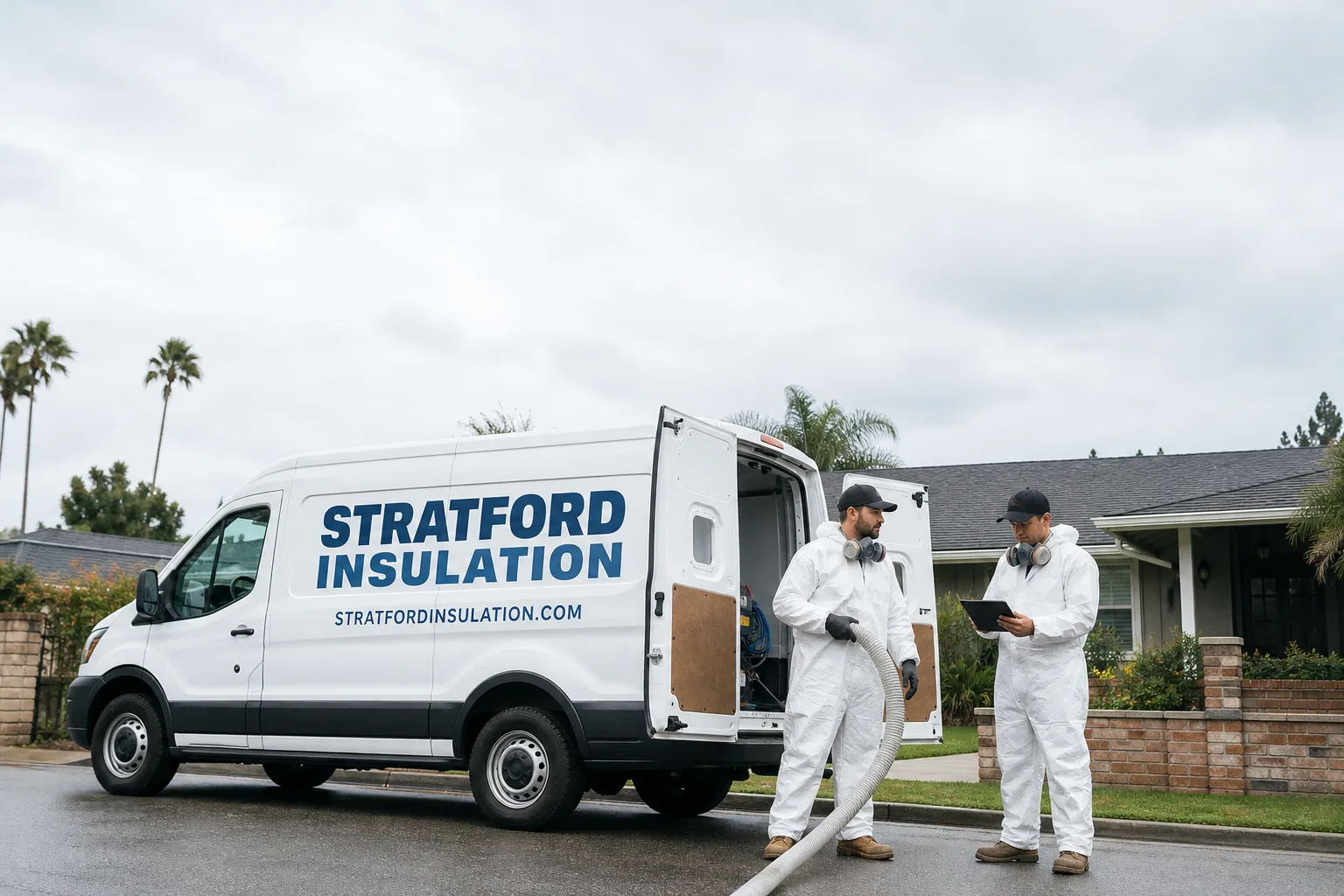
Fast, Reliable Spray Foam Insulation Across Brea
Spray foam insulation in Brea runs roughly $1.50 to $3.50 per board foot installed, with typical garage ceiling jobs landing between $1,800 and $4,200 and crawl space projects starting around $2,200. Most Brea homes we see need closed-cell foam for rim joists and open-cell for attic decks or garage ceilings. If your energy bills climb every August or your second floor never cools down, we can usually be at your Brea home within 24 to 48 hours. Call (844) 643-2736 and we’ll give you a straight answer on what your house actually needs.
Why Stratford Insulation Is Brea’s Preferred Spray Foam Insulation Company
Brea homeowners keep calling us because we don’t show up with one product and try to make it fit every house. We install both Icynene and Demilec spray foam lines, which means we can spec open-cell where you need air sealing and sound dampening, and closed-cell where you need R-value and moisture resistance. That matters in a city where a 1950s ranch off Imperial Highway and a 1990s two-story near Carbon Canyon have completely different insulation needs. Noel Caraway built Stratford Insulation around a simple idea: match the material to the problem, not the other way around.
We’ve worked in all three Brea ZIP codes long enough to know the patterns. Hillside homes in 92821 near Olinda get hammered by afternoon sun and Santa Ana wind loading that flatland tracts in 92823 never feel. Older central Brea neighborhoods like those around Arovista Park and the Brea Mall corridor tend to have original blown-in insulation that’s settled to nothing. When you call, we send a specialist who can read your attic and tell you what’s actually failing. Response time to most Brea neighborhoods is next-day, and emergency calls for exposed rim joists or failed foam get priority scheduling.
Crawl Space Spray Foam Insulation in Brea
Crawl Space Spray Foam Insulation in Brea is one of the most overlooked upgrades we do, especially in the older 1950s and 60s tracts where vented crawl spaces let cold air pour up through the floor every winter. Closed-cell foam on the rim joists and foundation walls stops that air movement, keeps dust and damp out, and can make the floors above feel noticeably warmer within a day of application. For most Brea crawl spaces we quote between $2,200 and $4,800 depending on square footage and access clearance.
Sealing Rim Joists Against Santa Ana Blowback
Santa Ana winds push dust, embers, and debris through unsealed rim joist gaps in ways Brea flatland homes rarely plan for. We apply closed-cell foam to rim joist cavities at a minimum 2-inch thickness, which blocks air movement and adds structural rigidity older floor framing often lacks. The foam also creates a fire-resistant barrier at the perimeter where wind-driven embers tend to collect during fire-season events.
Handling Tight Clears and Damp Soils
Crawl spaces in Brea’s hillside homes, particularly in the Carbon Canyon corridor, often have sloped grades and moisture that would break down fiberglass batts in a few seasons. Closed-cell spray foam handles that environment because it doesn’t absorb water or sag. We spec Demilec closed-cell here for its adhesion to damp concrete and its ability to hold R-value even when humidity spikes.
Garage Spray Foam Insulation in Brea
Garage Spray Foam Insulation in Brea is a job we recommend before you spend money on a mini-split or portable AC unit for that space. Uninsulated garages in Brea bake in summer, and that heat migrates into adjacent living areas, forcing your HVAC to work harder. Open-cell foam on the garage ceiling and the shared wall with the house runs $1,800 to $4,200 for most Brea garages depending on ceiling height and whether we’re foaming one wall or the whole envelope.
Why West-Facing Garage Ceilings Fail First
We recently sprayed open-cell foam in a 1960s ranch off Carbon Canyon Road where the west-facing garage ceiling had baked the original fiberglass into a brittle mat and salt air had corroded the door hinges and track fasteners. Our crew vacuumed out the degraded material, applied 5 inches of Icynene to the garage ceiling and rim joists, upgraded the door hardware to stainless hinges and nylon rollers, and sealed the attic penetrations to stop wind-driven dust. The homeowner reported the garage staying noticeably cooler and the door running quieter within a week.
Foam Plus Hardware for Coastal-Air Garages
Brea sits close enough to the coastal influence that salt air rides in on morning marine layers, and it eats garage door springs, hinges, and track fasteners years before the foam itself ever degrades. When we foam a Brea garage, we inspect that hardware first. If the springs show rust pitting or the rollers grind, we recommend stainless hinges and nylon rollers as part of the same job so you aren’t calling us back in eighteen months for a door that won’t lift.
Trusted Brands We Service in Brea
We bring Brea homeowners products from manufacturers builders actually specify. For spray foam work we install Icynene and Demilec, both leaders in open-cell and closed-cell chemistry. For homes where blown-in or batt makes more sense than foam, we also work with Owens Corning, Johns Manville, Knauf, Rockwool, CertainTeed, and GreenFiber. We carry enough local inventory in our Garden Grove shop to stage most Brea jobs without waiting on a distributor truck, which means faster turnaround when you’re dealing with a failed insulation layer. Our Spray Foam Insulation team handles everything from a single garage ceiling to a full attic encapsulation.
Common Spray Foam Insulation Problems We See in Brea Homes
- Corroded garage-door hardware compounding heat loss. Brea’s coastal salt air attacks springs, hinges, and track fasteners before foam fails. A garage with good foam and bad hardware still leaks conditioned air every time the door opens, which is why we bundle hardware upgrades with foam jobs.
- Sun-baked attic foam degrading at the surface. Foothill homes near Carbon Canyon and Olinda get intense radiant heat on west-facing roof decks. Uncoated open-cell foam can break down at the surface over time, shedding dust and losing R-value. We recommend a protective coating on canyon-side homes.
- Wind-driven dust and ember infiltration through unsealed penetrations. Santa Ana events push fine dust and airborne embers through every gap in a ceiling plane. Homes in the 92821 hills see this worst. Proper air sealing at wire chases, recessed lights, and plumbing stacks makes the difference between a tight attic and one that leaks heat all winter.
- Foam cracking at wood-to-foam junctions in older 1950s tracts. Mid-century Brea homes settle differently than newer construction. Rigid foam applied without accounting for that movement can crack at junctions where framing meets sheathing. We adjust foam thickness and application technique based on the home’s age and framing style.
Pricing for Spray Foam Insulation in Brea, CA
We Also Serve Cities Near Brea
We work throughout north Orange County, and our crews cover Brea plus Placentia, Fullerton, Yorba Linda, and La Habra Heights. If you live in those areas and need spray foam, blown-in, or attic insulation, we’ll schedule around the same timeline we offer Brea homeowners. Same specialist crew, same brand-backed installation standards.
Serving Brea, CA — Our Local Coverage Area
We’re based in the Brea area and know this community well. Use the map below to see our service coverage — if you’re nearby, we can almost certainly help.
FAQs About Spray Foam Insulation in Brea
Does spray foam insulation in a Brea garage need special hardware to resist salt-air corrosion?
Yes. Brea’s coastal air carries enough salt to corrode standard steel springs, hinges, and track fasteners years before the foam itself fails. When we foam a garage in Brea, we inspect and often upgrade to stainless steel hinges and nylon rollers as part of the job. That keeps the door operating smoothly and prevents air leaks around the door frame from compounding your heat-loss problem. Call (844) 643-2736 and we’ll walk through what your garage needs.
Why do foothill homes near Carbon Canyon need a different spray foam spec than flatland tracts in Brea?
Foothill homes near Carbon Canyon and Olinda sit directly in the path of stronger Santa Ana wind gusts and get more hours of direct afternoon sun than flatland tracts in the central and southern parts of the city. That means we spec thicker foam at roof-deck junctions and recommend protective coatings on west-facing attic surfaces to prevent surface degradation and dust infiltration. Flatland homes need standard thickness but tighter air sealing at ceiling penetrations.
Can spray foam insulation help with Santa Ana wind-driven dust and embers in Brea?
Yes, but only if it’s installed as part of an air-sealing strategy, not just sprayed onto a surface and left alone. The key is sealing every penetration in the ceiling plane: wire chases, recessed light housings, plumbing stacks, and the perimeter rim joists. Closed-cell foam at those points stops wind-driven dust and embers from being pushed into the attic in the first place. In 92821 hillside homes especially, we recommend this treatment every time.
What brands of spray foam do you use for Brea homes?
We install Icynene and Demilec spray foam products. Icynene’s open-cell foam is our go-to for garage ceilings and attic roof decks where you want air sealing without adding too much weight to older framing. Demilec’s closed-cell line is what we use for rim joists, foundation walls, and any area where moisture resistance matters. Both brands give us the flexibility to match the foam to the problem instead of forcing one product onto every house. Call (844) 643-2736 for a recommendation based on your home’s condition.
How does Brea’s mix of mid-century and newer homes affect spray foam installation?
It changes everything about how we prep and apply. Mid-century tracts from the 1950s and 60s often have minimal original insulation, older wiring runs through attic spaces, and framing that has shifted over decades. We inspect for knob-and-tube remnants, check junction boxes before sealing, and adjust foam thickness to accommodate movement. Newer foothill homes from the 1990s often have cathedral or vaulted ceilings with narrow rafter bays that require careful open-cell application to avoid over-expansion damage. Different house, different approach.
Written by Noel Caraway, Owner at Stratford Insulation, serving Brea and north Orange County with brand-backed spray foam, attic, and blown-in insulation systems.